
Searching Knox County Criminal Dockets
Start your Knox County criminal docket lookup with Indiana MyCase, the main free public tool. It offers Case, Name, and Attorney search modes. Nothing beats a full cause number. It pinpoints both the case and its court in one step. Without the number, run a name search first. Then narrow the field with a first or middle name, date of birth, court, status, or filing dates. Just remember that public results are informational summaries rather than certified court records.
- Choose Case search and enter the full cause number, with or without hyphens and leading zeroes.
- If needed, choose Name search, add enough name detail, select a Knox court, and use Status All for older matters.
- Compare the court, filing date, case type, and status before opening the result.
- Read the newest CCS lines for the charge, setting, order, plea, and disposition.
- Contact the Knox County Clerk of the Courts for a missing document, older file, or certified copy.
The Indiana Judicial Branch Knox County page gathers the statewide tools and local court resources in one spot, including MyCase access for Knox County criminal docket searching.
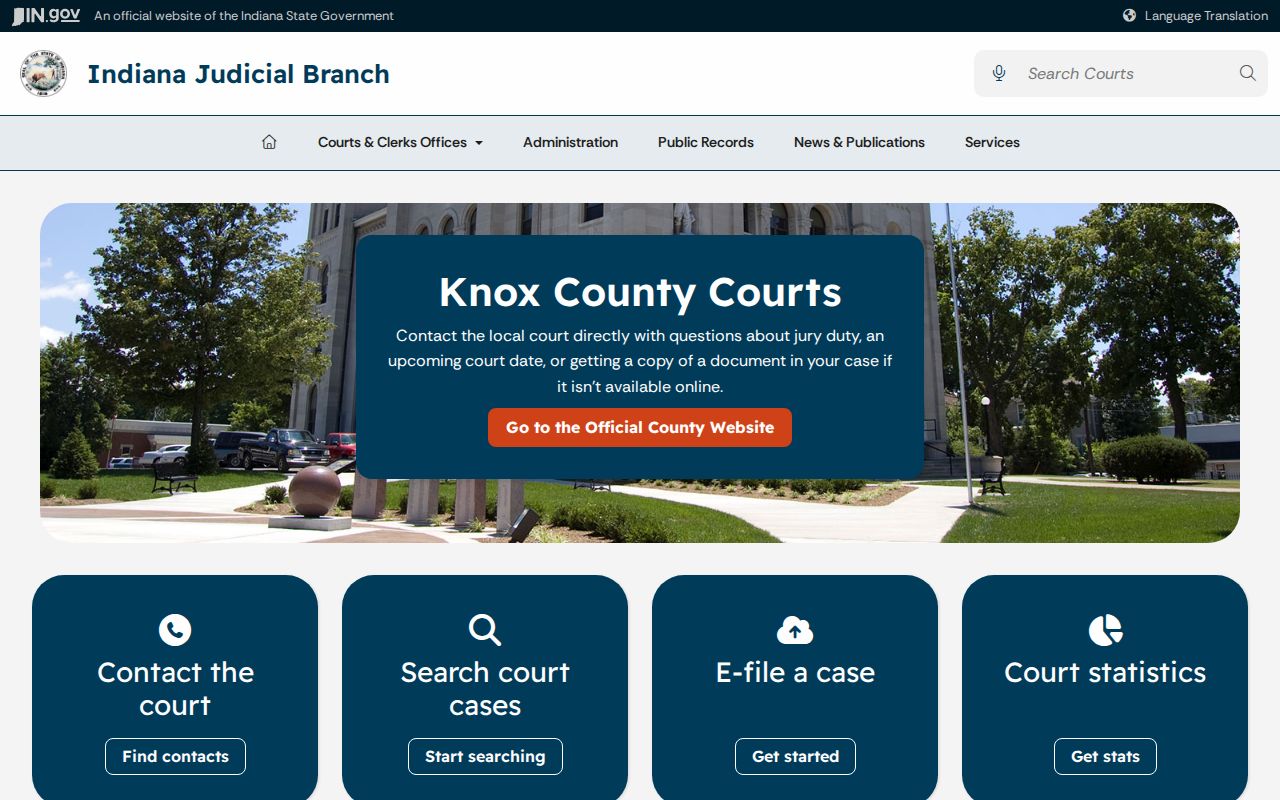
The page also separates case search from e-filing, statistics, and local rules, each of which serves a different court function.
Knox Criminal Cause Codes
Cause numbers in Indiana carry routing details inside them. The county code 42 flags Knox County. Current prefixes are 42C01 for Circuit Court, 42D01 for Superior Court I, and 42D02 for Superior Court II. After the prefix comes the filing year and month, then the case type and a six-character sequence, as in 42C01-2402-F5-000013.
- MR and F1-F6
- Murder and Level 1 through Level 6 felony codes.
- CM
- A misdemeanor cause, now assigned to Superior Court II by local rule.
- IF and OV
- Infraction and ordinance causes, also assigned to Superior Court II.
- XP
- An expungement type, not a new criminal charge.
A transfer can rewrite the court identifier, so search the full number and read the reassignment entries instead of guessing from the offense label.
Inside a Knox County Criminal Docket
The running record in a Knox County criminal docket is the Chronological Case Summary, or CCS. It lists, in date order, what the court filed, heard, or ordered. But it is not the whole file. Police reports and discovery may stay out of reach. So can exhibits, treatment records, and sealed material.
| Cause number | Knox court prefix, filing year and month, type code, and sequence. |
|---|---|
| Charges and counts | Filed offense levels and later amendments or dismissals. |
| Appearances | Probable-cause, bond, arraignment, pretrial, motion, trial, and sentencing events. |
| Filings and orders | Dated motions, notices, rulings, and administrative entries. |
| Plea and disposition | The recorded plea, verdict, dismissal, sentence, or other outcome. |
A closed status does not put every document online, and a missing download does not mean the filing was never made.
Knox Felony Court Routing
Don't assume every Knox County felony lands in Circuit Court. The current Knox local rules split that work among the trial courts. Level 1 through Level 4 felonies are divided between Circuit and Superior I. Murder-related matters are divided there as well. Circuit takes every Level 5 felony outright. Level 6 cases are split between Circuit and Superior II. Habitual-traffic-offender felonies go to Superior II.
The official Superior Court I page lists that office. It appears among the courts sharing Knox County criminal docket work.
That listing lets you match a 42D01 cause to the court that can confirm its current setting. The official Superior Court II page covers the separate office at 620 Busseron Street.
That address matters for 42D02 causes, misdemeanors, infractions, and assigned felony work.
How a Knox Criminal Case Moves
A Knox County criminal docket grows in stages. The first entry may record filing or probable-cause action. Next comes an initial appearance or arraignment. That step addresses the charge and plea. Pretrial entries can pile up: appearances, discovery notices, motions, bond review, continuances, and scheduling orders. A plea agreement or trial then carries the case toward disposition and, when required, sentencing.
Docket flow: Filing › Arraignment › Pretrial › Plea or Trial › Disposition › Sentencing
Always read the latest entry. A hearing stays in the history after a reset, and charges can be amended before final disposition, so read the series rather than one isolated line.
Knox Bond Entries in Context
Knox Local Rule LR42-CR-2.1 sets the local framework for probable-cause and bond entries. Someone held after a warrantless arrest cannot sit in jail past 48 hours without probable-cause and bond action. The rule includes a schedule by offense level. A warrant or a judge's order can still set different terms. Murder carries no bail under the schedule. Certain domestic or family-violence matters carry a stated 48-hour no-bail period. Unless a court orders otherwise, the rule permits a ten percent cash deposit. The Clerk takes that deposit. Once obligations are met, the Clerk generally returns 90 percent. The Clerk keeps the statutory share the rule describes. Failure to appear triggers a forfeiture-notice process. These rules explain the docket terms, but the current judicial order controls any specific case. Note: A bond schedule supplies context only. So confirm active terms from the newest Knox County criminal docket order.
Courts That Hold Criminal Dockets
Where do the official trial records sit? Circuit, Superior I, Superior II, and Magistrate matters all live with the Knox County Clerk of the Courts. The Magistrate hears assigned county causes but keeps no separate public case database. So search the underlying cause first. Then contact the court shown when a live setting needs confirmation. The official Magistrate Court page gives its public office and contact route.

The Magistrate is a hearing office within the county system, not a fourth independent criminal docket keeper. Federal criminal cases sit entirely outside it. Knox federal matters belong to the Southern District of Indiana's Terre Haute Division, searched through PACER or CM/ECF rather than MyCase.
Knox Problem Solving Court Entries
A criminal charge does not always stay on the ordinary track. Knox Local Rule LR42-AR-3.9 allows a judge to refer a defendant to Problem Solving Court. The referral can come once charges are filed. Acceptance can move the case for admission or disposition. Indiana law and program policy guide that step. What shows up in public CCS entries varies. You might see a referral, a review, a transfer, or a later court action. Supervision notes, testing, medical details, and treatment records generally stay restricted. The county's own Drug Court description documents the certified court-managed program and its structure.
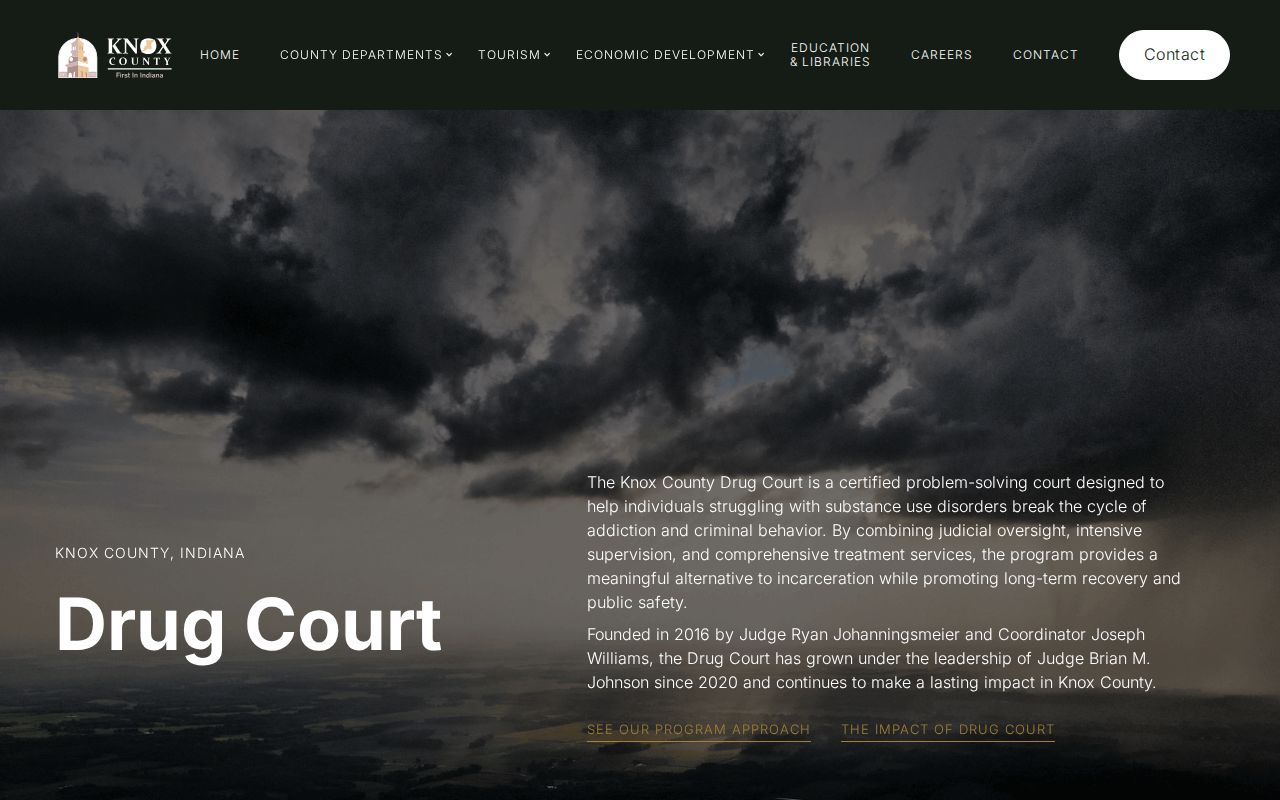
To search publicly, track the underlying cause number rather than looking for a participant list. The related Alcohol and Drug Program page describes another court-connected service.
It is a service and referral office, not a separate Knox criminal docket portal.
Sealed Dockets and Public Access
Indiana treats court records as public by default. The rule has teeth, though, and limits are written into it.
A Knox County name search can leave out confidential cases and juvenile matters. Sealed records may not appear. The same goes for protected personal data and certain documents open only to parties or their attorneys. So a missing result proves nothing about whether a case exists.
Key rules:
Indiana Criminal Rule 1.2 makes criminal records public subject to access rules.
Access Rule 4 states the public-access presumption.
Access Rule 5 identifies confidential cases, sealed material, and protected data.
MyCase is informational only. For the official docket, older files, or a certified copy, go straight to the Clerk at 812-885-2521, clerk@knoxcounty.in.gov, or 111 North 7th Street in Vincennes. The county's general web form can open a question, but it is not a proven form for ordering copies.
When Knox MyCase Falls Short
When a Knox County docket search comes up empty, the cause is usually mundane. Maybe the court filter is wrong. Maybe the date range is too tight, or the cause transferred elsewhere. Or an older record simply has no images online.
MyCase may also throw up a CAPTCHA after repeated requests. Stop rather than try to get around it. A few practical fixes help. Enter the exact cause number without punctuation. Set Status to All. Then check each plausible Knox court before calling the Clerk.
The official Odyssey courts list records the identifiers and conversion history behind the public system. That registry explains why court codes and converted records matter. When the public view falls short, the Clerk still has the last word.